
Recently, I sat down with two clients who, on paper, were doing everything right. Both were worried about their SEO, but when I opened the hood, I found that their technical SEO was solid and their on-page optimization was either polished or well underway.
They weren’t looking for “SEO 101.” They were ready for the deep stuff: building buyer journeys, scaling content, and figuring out the marketing mystery of why their high-quality sites weren’t converting.
These two companies couldn’t have been more different:
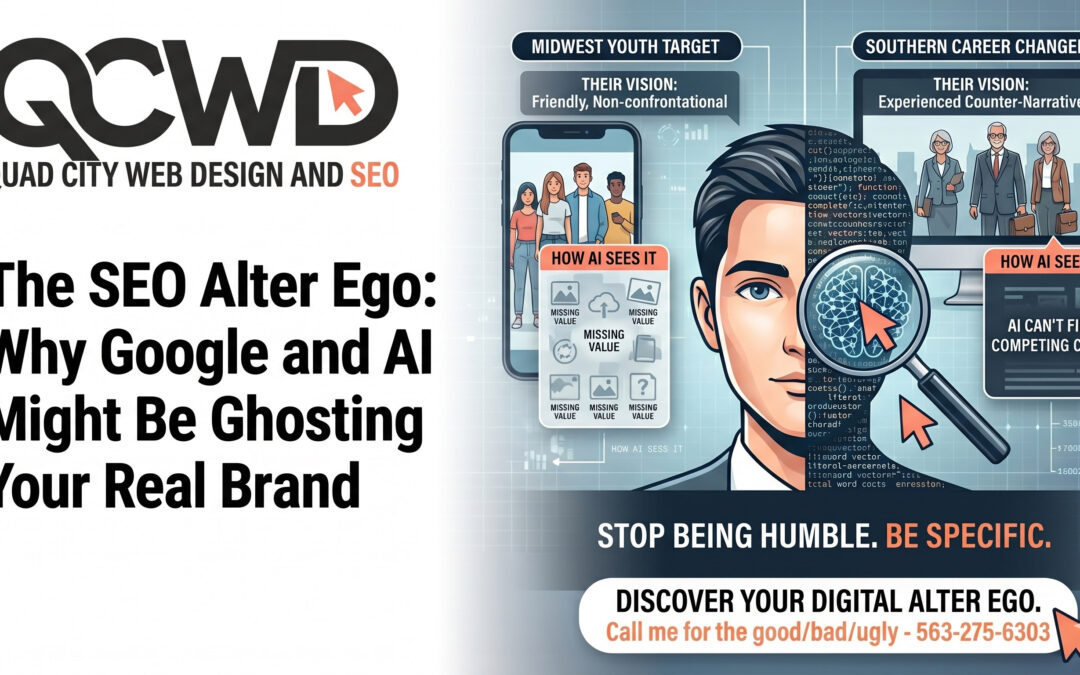
- Company A: Based in the Midwest, targeting the 18–25 demographic.
- Company B: Located in the South, targeting career changers in their later years.
There was zero overlap in their industries or their audiences. But as I started digging into how Google perceives them, I stumbled onto something fascinating. The narrative these companies thought they were telling the world was not at all what Google was hearing.
Intrigued, I went deeper. I wanted to see how AI engines—the new gatekeepers of information—saw them. That’s when I got hooked. It was like reading a mystery novel and hitting the ultimate plot twist: AI reiterated exactly what Google was telling me.
The Great Brand Disconnect
Both of these clients had spent years cultivating a specific image. Yet, in the eyes of search engines and AI, they both had a complete alter ego. When I presented my findings, they were flabbergasted. They hadn’t realized that the “small things” on the internet—the way sentences are structured and the specific words chosen—were triggering entirely different identities.
Case Study A: The Cost of Being “Too Nice”
Company A has a specific marketing rule: never be confrontational. They want to be the “friendly neighbor” brand. Unfortunately for them, Google and AI don’t have a “read between the lines” setting.
Because Company A was constantly implying their value rather than stating it, the algorithms missed the point entirely. To fix their search presence, they need to be blunt and explicit. Ironically, the very thing they feared—being direct—is the only way to get Google to understand who they actually are.
Case Study B: The Silent Rivalry
Company B has a fresh competitor making big, concise waves in the market. To fight back, Company B wrote a beautiful narrative to counter the competitor’s claims.
The problem? They never explicitly called the competitor out or directly addressed the specific claims. Because they were being “classy” and subtle, Google and AI couldn’t connect the dots. The counter-narrative they worked so hard on was invisible because the algorithms didn’t know what it was supposed to be countering.
Stop Being Humble
After these two encounters, my advice is simple: Be specific. Be blunt. Brag a bit.
You might have the best product on the market. Your “word of mouth” might be legendary. But if you are being humble in your digital copy, Google and AI are going to skim right over your modesty in favor of the competitor who is willing to put it all out there.
Subtlety is a human trait; algorithms are literal. Google and AI are a lot like me with social cues—if there’s a subtext, I probably missed it. If you want to be my friend, you have to ask. If you want to be the top search result, you have to say exactly who you are and why you’re better.
- Write the blog.
- Film the video.
- Build the comparison charts.
- State exactly what you mean.
What is your “Digital Alter Ego”?
Does the world see the brand you built, or has Google created a version of you that you wouldn’t recognize? If you want to know what Google and AI actually think you represent, give me a call, 563-275-6303. I’ll do a deep dive and let you know exactly what’s happening—the good, the bad, and the ugly. Let’s make sure your online identity actually matches your real-world excellence.

Recent Comments