

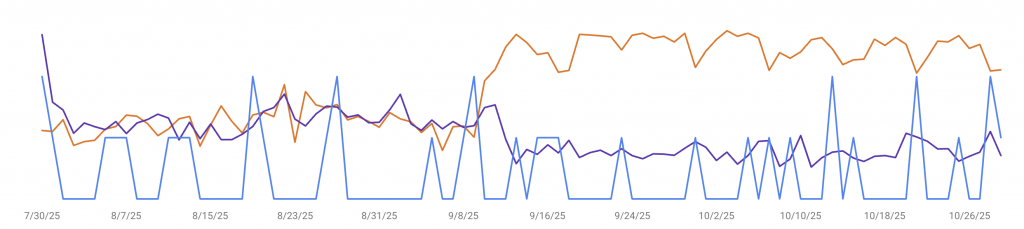
If your Google Search Console (GSC) reports took a sudden nosedive in mid-September, you’re not alone. I’ve heard the panic, and I’ve seen the charts. Metrics like “Impressions” and “Total Keywords” plummeted for nearly 90% of sites overnight.
As a seasoned SEO strategist, my job is to cut through the noise and tell you the truth: Your website performance did not crash. Your data got a much-needed correction.
Google’s quiet removal of the &num=100 URL parameter is a technical change that is forcing the entire industry to grow up. Here is my expert breakdown of what happened, why it matters, and how to use this moment to gain a competitive edge.
1. The Technical Truth: What Google Really Removed
For years, SEO tools, rank trackers, and even power users leveraged a hidden URL trick: appending &num=100 to a Google search query. This forced the Search Engine Results Page (SERP) to display 100 organic listings on a single page, instead of the default 10 (Source 1.6).
This seemingly innocent parameter was the backbone of how tools gathered vast amounts of ranking data quickly. Then, in September 2025, Google quietly deprecated it (Source 1.5).
Why the change? While Google hasn’t issued a formal statement, the consensus among experts is clear: this was a direct move to combat large-scale data scraping by automated bots and, most significantly, by Large Language Models (LLMs) used for AI training (Source 1.1, 2.7). Google essentially put up a major speed bump to protect its infrastructure and data supply.
2. Why Your Reports Look Worse (And Why That’s a Good Thing)
This is the most critical point for every business owner to understand. The dramatic drops you’ve seen are an illusion—a reporting correction, not a loss of visibility.
The problem was that the &num=100 parameter led to inflated metrics in your GSC reports.
- The Impression Drop (The Panic): Several studies confirmed that a staggering 87.7% of websites saw a decline in impressions (Source 1.2, 1.3). This is because every time a rank tracker loaded a single page with 100 results, Google counted 100 impressions for that query, even for listings at position 95 that no human would ever scroll to (Source 3.2). With the parameter gone, the bot-generated, artificial impressions have vanished. Your new impression count is simply a more accurate reflection of what actual users are seeing.
- The Average Position “Improvement”: If you saw your average ranking position suddenly look better, don’t celebrate just yet. This is another side effect. By no longer counting those deep, low-ranking positions (50-100), the overall average is skewed toward your higher-ranking, more meaningful keywords (Source 1.6).
- The Keywords That “Vanished”: Similarly, around 77.6% of sites lost visibility for some unique ranking terms (Source 1.3). Those “lost” keywords were likely buried deep on pages 5 through 10, positions that rarely generated real business traffic anyway.
The Bottom Line: Your real traffic and conversion numbers are likely stable because this change did not affect user behavior—it only corrected how your website’s visibility was measured (Source 1.5).
3. A New Reality: The Financial Impact on SEO Tools
The change doesn’t just affect reporting; it changes the cost of doing SEO.
To collect the same 100 positions of data, SEO tools like Semrush and Ahrefs must now perform up to 10 separate requests instead of one (Source 1.1). This multiplies their infrastructure costs, bandwidth usage, and API calls (Source 1.5).
As a business owner, you should expect one of two things from your SEO tool vendor or agency:
- Increased Costs: The higher data collection costs will be passed on to the user through price hikes.
- Reduced Depth: Many tools are limiting their default daily rank tracking to the Top 20 or Top 30 positions to keep costs manageable (Source 1.6, 2.2).
4. Your Expert Strategy: Shifting Focus to True Business Metrics
This change is not a crisis; it’s a gift. It forces us all to stop obsessing over vanity metrics and focus on what truly drives revenue. Here’s my no-nonsense plan for your business moving forward:
- Re-baseline Your KPIs: Wipe the slate clean. Treat mid-September 2025 as the data breakpoint for all historical comparisons (Source 1.5). Establish a new, more honest baseline for impressions and keyword volume.
- Focus on Clicks and Conversions: Impressions were always a supporting metric. Your North Star KPIs must be Clicks, Click-Through Rate (CTR), and Conversions (Source 1.3). These metrics were largely untouched by the parameter removal and reflect actual user intent.
- Prioritize Page One (Positions 1-10): The days of tracking rankings at position 85 are over. This change reinforces what has always been true: nearly all your traffic comes from the first page of results. Double down on strategies that push your most valuable keywords into the Top 10 (Source 1.1).
- Demand Transparent Communication: If your current SEO partner is panicking or can’t clearly explain the difference between a “data drop” and a “performance loss,” it’s time to ask hard questions (Source 2.6).
The removal of &num=100 is the single biggest reporting shift Google has made in years. It’s forcing the SEO industry to move away from inflated data and toward a smarter, more accurate measure of performance.
We’ve adapted our tracking methodologies to navigate this new environment, ensuring your strategy remains focused on delivering genuine, high-value traffic.
If you’re ready to partner with an SEO expert who focuses on conversions, not confusing metrics, let’s talk about establishing your new path to page-one dominance.

Sources
1.1 Impact of Google’s num=100 Removal on Search Visibility | ResultFirst 1.2 77% of sites lost keyword visibility after Google removed num=100 – Search Engine Land 1.3 Google’s num=100 Removal: What It Means for Your SEO – eSEOspace 1.5 Google Disables &num=100 parameter: What it Means for SEO & Tracking – Arc Intermedia 1.6 Google Ends &num=100: What It Means for SEO Data & SMBs – Logical Position 2.2 Google drops &num=100 parameter – How it changes rank tracking in Morningscore 2.6 Google Removes the num=100 Parameter: Impact on Your Results and Google Search Console Impressions – Yourban.ai 2.7 Google removing number=100 is actually good news for SEOs – Reddit 3.2 Google just removed &num=100 – Embryo
Recent Comments